

Product display

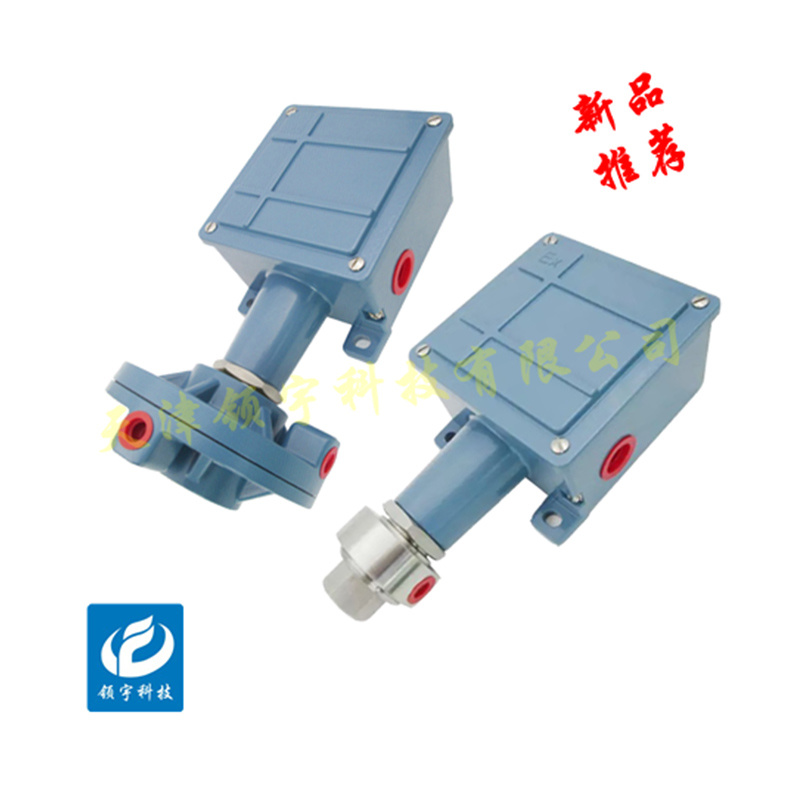


LPS-C1 Diaphragm Differential Pressure Switch
● Fully welded diaphragm, zero leakage
●Mechanical principle, no power required
● High-quality microswitch with minimal dead zone
● The process interface is versatile, and both flanges and threads can be customized.
Key words:
Classification:
Download information:
Product Description
Product Overview Product overview
The LPS-C1 series differential pressure switches feature a diaphragm-type differential pressure sensing element. The standard model can accurately control the pressure difference of non-corrosive gases, liquids, or steam, while the explosion-proof version is suitable for monitoring pressure differences in environments containing explosive gas mixtures classified as IIA, IIB, or IIC, with temperature groups ranging from T1 to T6. With its fully welded stainless steel diaphragm design, these switches are simple to use, highly reliable, and prone to fewer failures—effectively preventing leakage and false operations. Additionally, the setpoint is adjustable, requiring no separate power supply, and the contact capacity is robust, making them convenient for on-site applications. They are widely used across industries such as petroleum, chemical processing, metallurgy, power generation, sugar production, pharmaceuticals, and other sectors that demand precise differential pressure control.
Measurement Principle Principle
A diaphragm-type pressure switch is a mechanical pressure switch that uses the mechanical deformation of a diaphragm to control the closing or opening of electrical contacts. When the pressure of the measured medium changes, the diaphragm undergoes a corresponding displacement. This displacement is then transmitted via a linkage mechanism to a microswitch. Once the displacement reaches a preset value, it actuates the microswitch, causing its contacts to either close or open—thus signaling the pressure level. Adjustable pressure switches allow users to fine-tune the relationship between the linkage mechanism and the microswitch contact travel, enabling precise pressure control at either a fixed value or within a specific range, thereby achieving the desired operational purpose.
Performance Metrics TECHNICAL PARAMETERS
Measurement medium: Gas or liquid (For highly corrosive applications, please confirm beforehand)
Measurement range: 0–2.0 to 2500 kPa
Working viscosity: ≤10E3 m²/s
Housing material: Die-cast aluminum, epoxy resin coating, with a sealing gasket on the outer cover
NEMA Protection Rating: Meets NEMA 4X requirements
Set value accuracy: ±0.5%
Repeatability accuracy: <1%
Pressure interface: Standard 1/2 NPTF internal thread, M20×1.5 external thread; special interfaces available upon request.
Electrical interface: M20×1.5 internal thread; special interfaces available upon request
Switch output: One single-pole double-throw (normally open + normally closed) output;
Switching component: Microswitch
Ambient temperature: -40°C to +70°C
Environmental humidity: 5%–95%
Cycle Life: 1 million cycles
Protection Rating: IP67
Explosion-proof rating: Exde IIC T6 Gb
Dust Explosion Protection: ExtD A21 IP66 T80℃;
Contact capacity: Standard type: 380V, 15A; Explosion-proof type: 380VAC, 5A;
External dimensions APPEARANCE OF SIZE

Installation Requirements INSTALLATION
1. Weld the pressure-tapping pipe, and it’s best to install a shut-off valve on the pipe. Leave threaded connections corresponding to the switch, allowing for easy removal of the switch during maintenance.
2. Install the switch in a location with minimal vibration and temperature fluctuations. An appropriate installation spot can effectively prevent moisture from entering the housing. If the switch will be installed under harsh operating conditions, it must be mounted vertically (with the pressure connector facing downward). Please avoid installing it in environments outside the specified temperature range.
3. Special note: When installing or removing, never directly twist the outer casing to secure or detach the switch. Instead, use a wrench to tighten or loosen the connecting hexagonal (or flat) fitting at the joint.
Previous Page
Next Page
Previous Page
Next Page
Related Products
Product inquiry
If you are interested in our products, please leave your e-mail, we will contact you as soon as possible, thank you!
Tianjin Ling Yu Technology Co., Ltd.
Operator:86-22-58554679
Fax: 022-58285528
Manager Ding: 86-18902041592
WhatsApp:8618902041592
Complaint Hotline:86-15822286986
Factory Address: No.5 Yingbin Road, Xiqing District, Tianjin
E-mail:sales@lingyukeji.com
Purchasing Department E-mail:lykj_tj@163.com
WhatsApp Scan

Copyright©2022 Tianjin Ling Yu Technology Co., Ltd